


Precise IQ Engine
Simple. Clear. Precise.

Precise IQ Engine
Simple. Clear. Precise.
Neuro Clinical Gallery
Precise IQ Engine (PIQE)
PiQE is Canon Medical’s high resolution Deep Learning Reconstruction for MRI. PiQE increases matrix size, removes noise, and delivers sharp anatomical images to take MR imaging to the next level.
Brain
Vantage Galan 3T
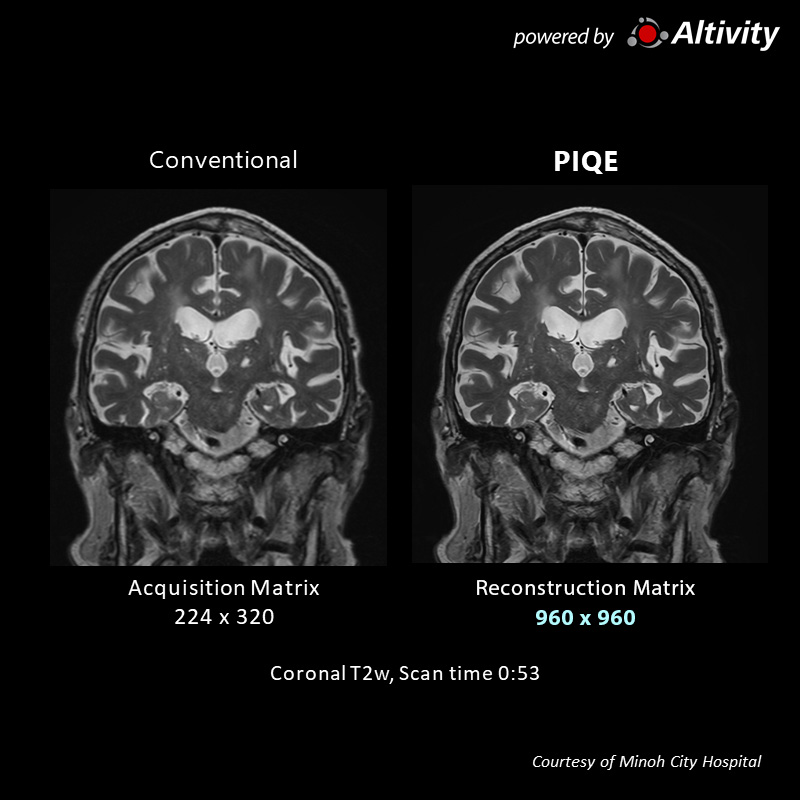
Cor T2w for hippocampus
Example of a high-resolution image of the hippocampus using Precise IQ Engine (PIQE). The original image is 256 matrix with low resolution and high signal-to-noise ratio (SNR).
Even though the scan time is reasonably short and the slice thickness is as thin as 2 mm, the image is clear and demonstrates good contrast.
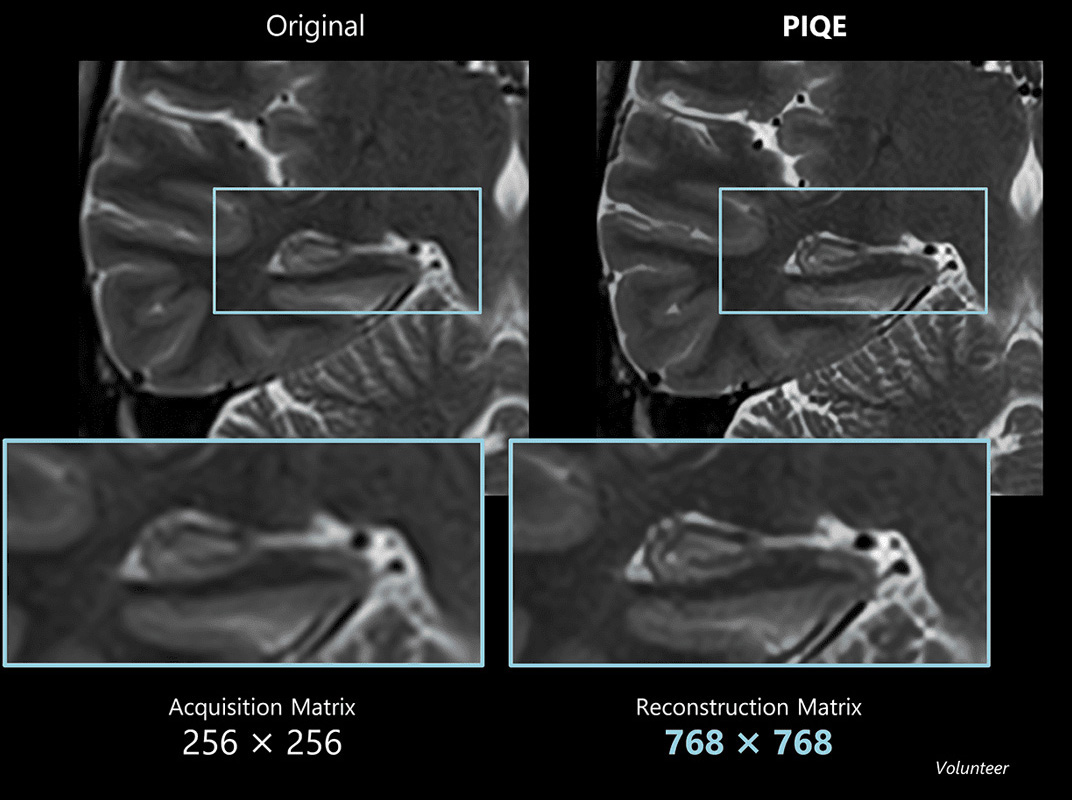
Brain
Vantage Galan 3T
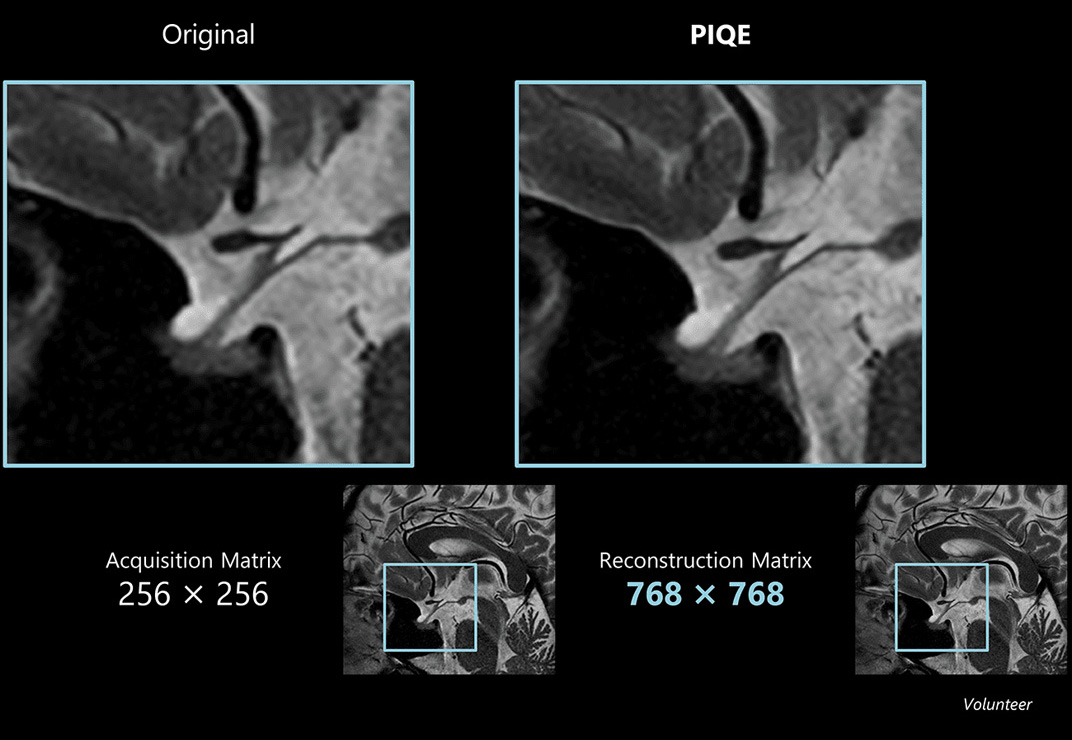
Sag T2w for pituitary
Using a regular head and neck coil, with a collection matrix 256 × 256 setting, imaging can be performed in approximately 1 minute. Structures around the pituitary gland are clearly visible.
Acquisition time: 1:08
Brain
Vantage Galan 3T
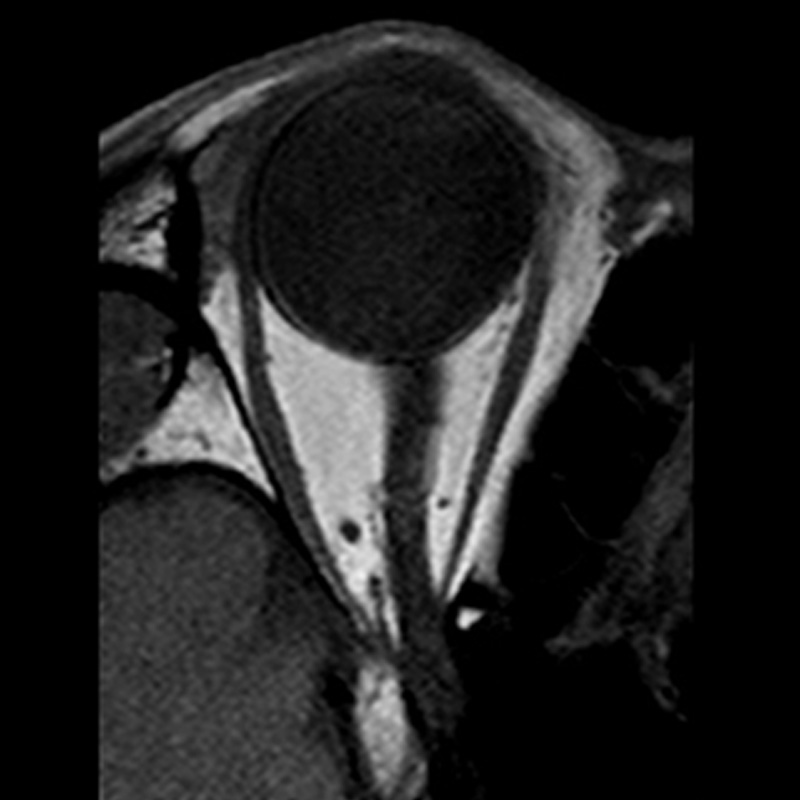
Axi T2w for orbit
Orbit image. Did not require a dedicated coil such as a circle coil to image the orbit. The image can be acquired in only 30 seconds using a normal head/neck coil with a small field of view (FOV) and low resolution. The structures around the lens are clearly visible.
Acquisition time: 0:36
Common filter
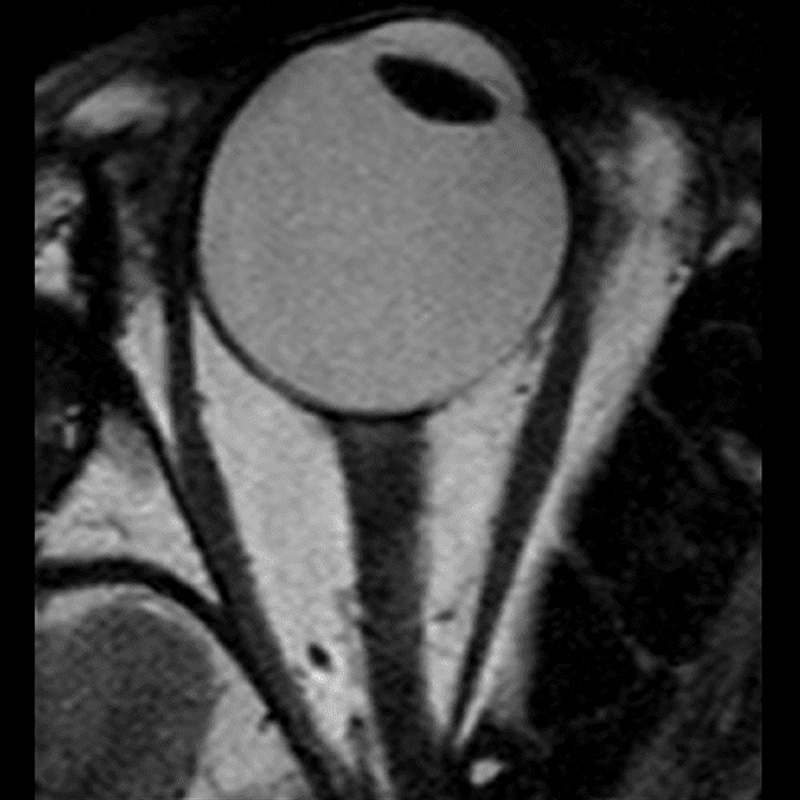
Reconstruction Matrix
192 x 192
PIQE 3x3
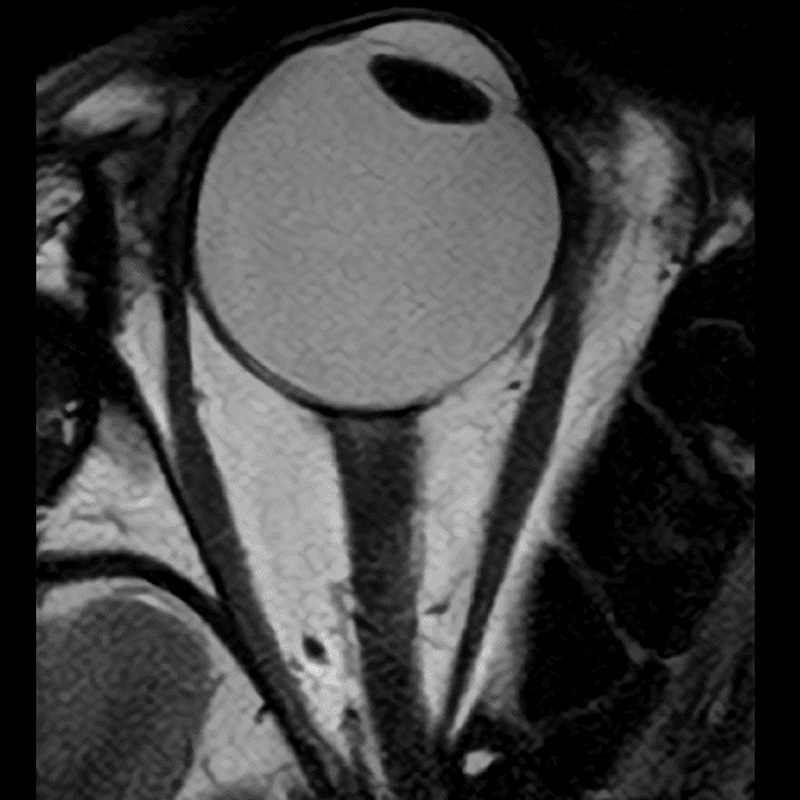
Reconstruction Matrix
576 x 576
Brain
Vantage Galan 3T
Axi T2w for Brain
As this case is acquired with a 3T system, increasing the matrix over 512 × 512 will result in poor SNR and reduced contrast.
PIQE was applied after reducing the matrix to improve SNR and further shorten the scanning time.
As a result, scan time was reduced by 52% while still achieving high resolution.
Conventional
Axial T2w, Acquisition matrix 384 x 384, 0.58 x 0.58 mm resolution, 4 mm, 2:42

Conventional
Axial T2w, Acquisition matrix 320 x 320, 0.7 x 0.7 mm resolution, 4 mm, 1:18
PIQE
Axial T2w, Reconstruction matrix 960 x 960, 0.46 x 0.46 mm resolution, 4 mm, 1:18
Courtesy of Rothschild Foundation Hospital, France
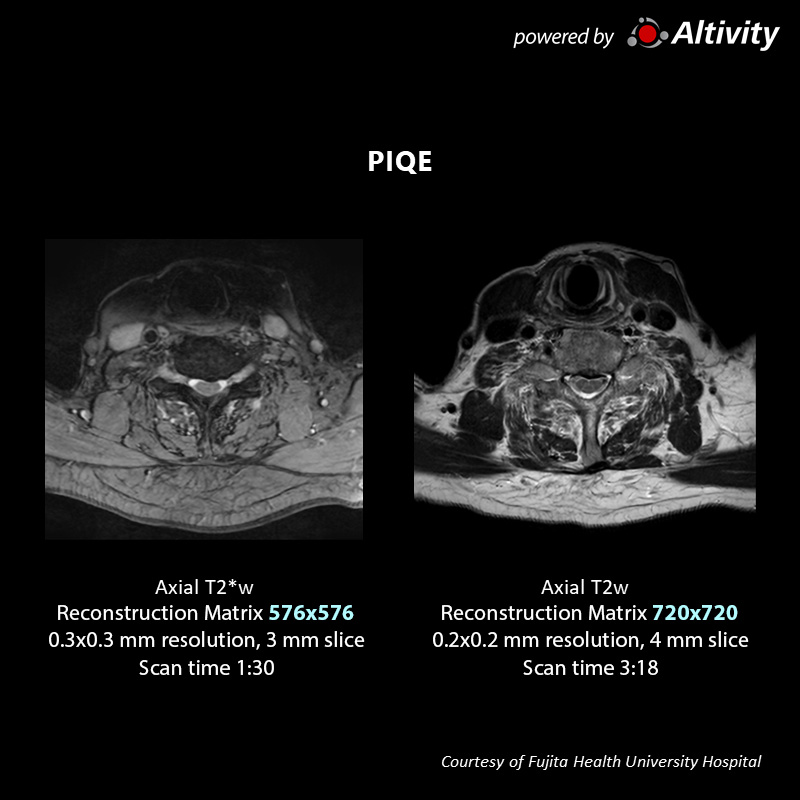
Neuro & Spine
Vantage Galan 3T
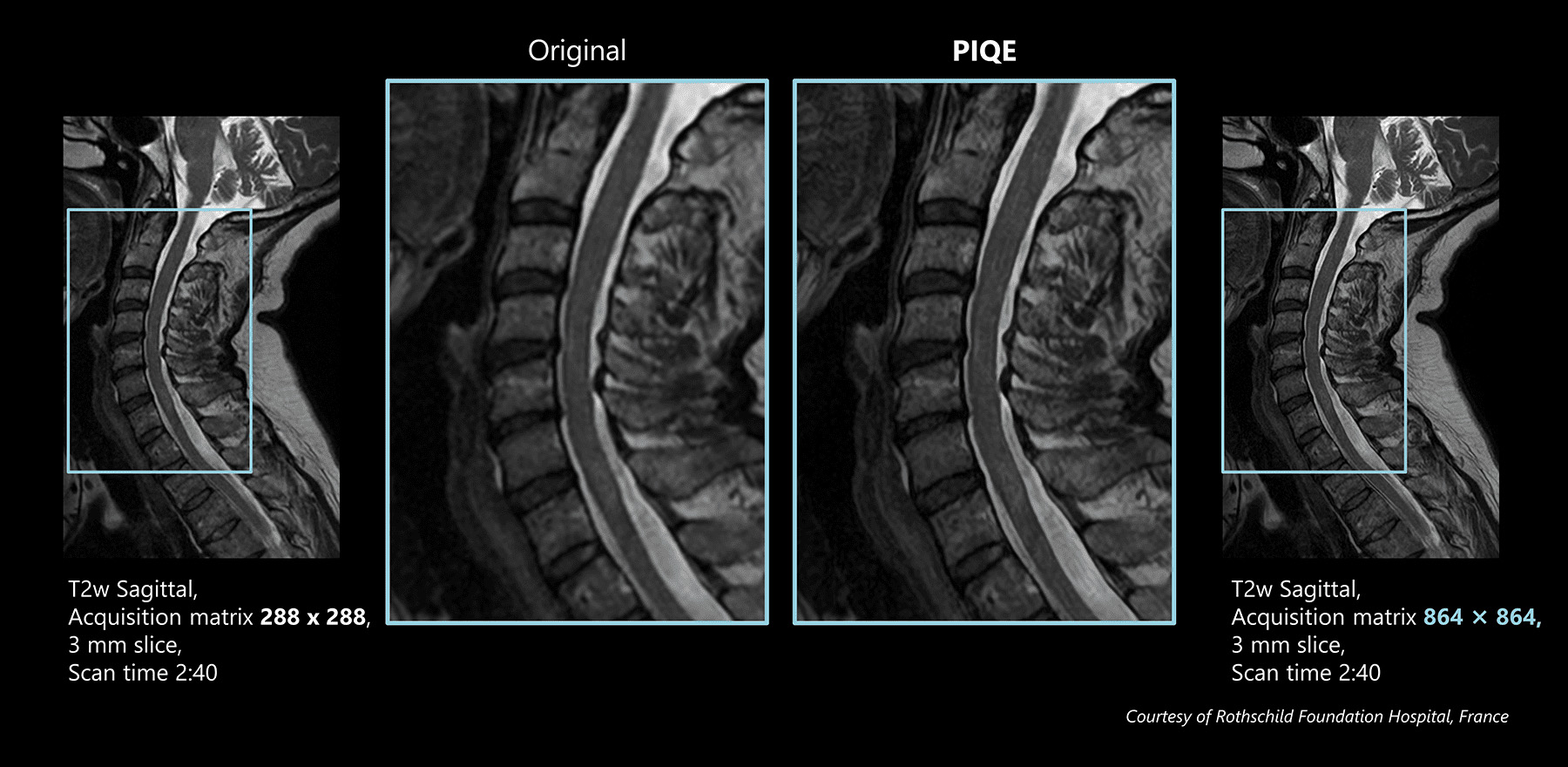
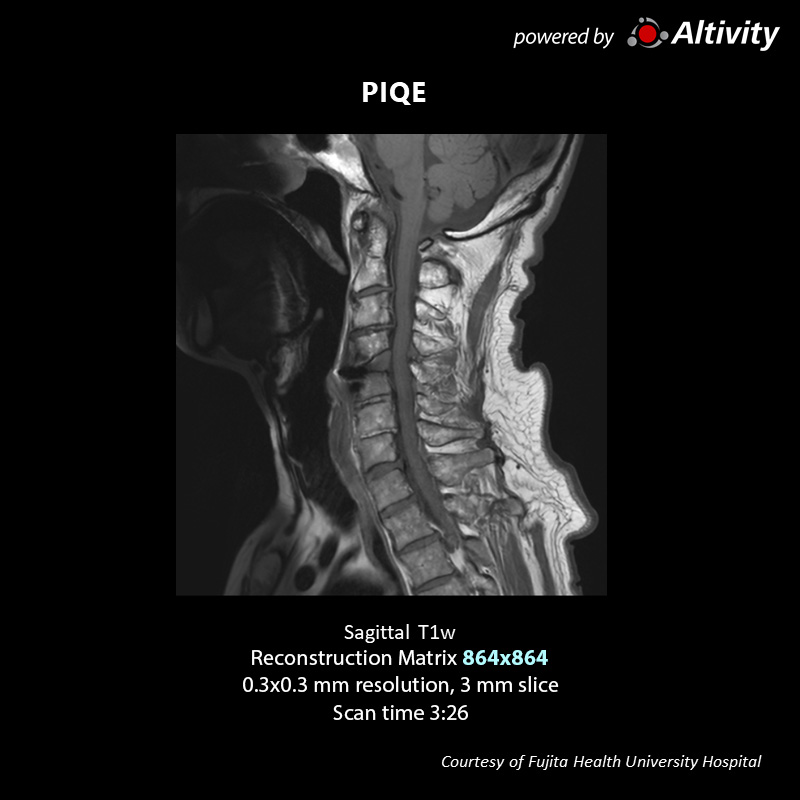
Sagittal T2w for c spin
The original image is a 288 matrix with a 3 mm slice thickness and relatively low resolution, resulting in high SNR.
PIQE reconstruction can acquire high quality images within acceptable scan times.
Neuro & Spine
Vantage Galan 3T
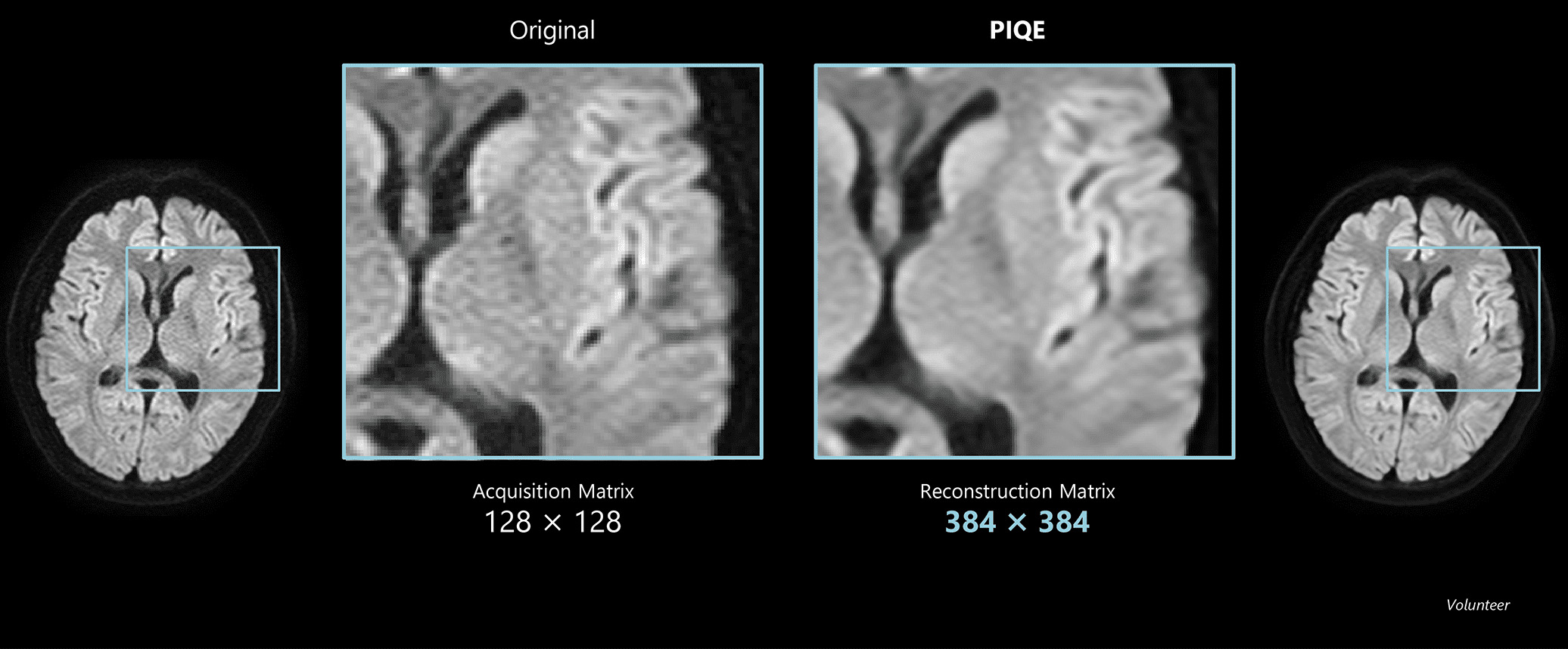
Axial FE2D T2
Volunteer image with PIQE adapted to SEEPI DWI sequence.
Structural detail can be more finely captured at three times the resolution with PIQE.
Neuro & Spine
Vantage Galan 3T
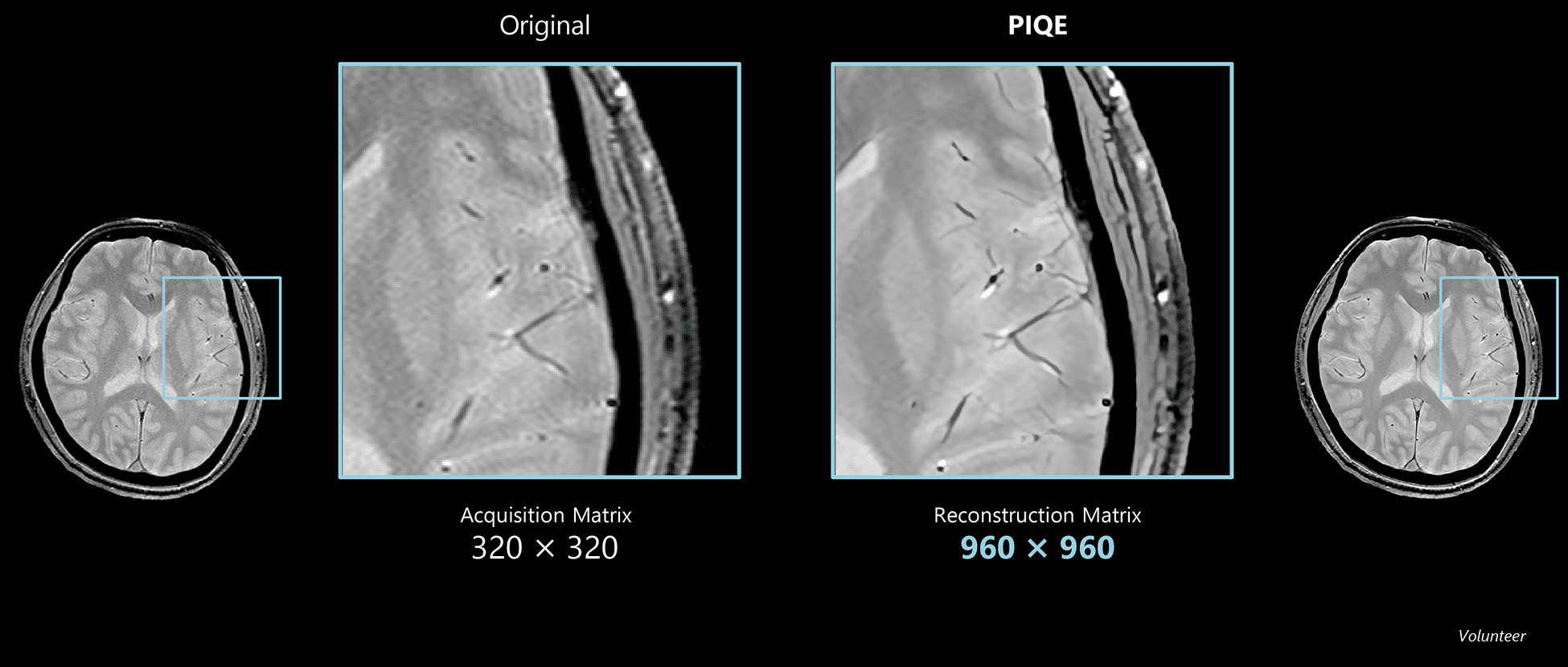
Axial FE2D T2
Volunteer image with PIQE adapted to FE2D T2 sequence.
Ringing artifacts are reduced by PIQE reconstruction.
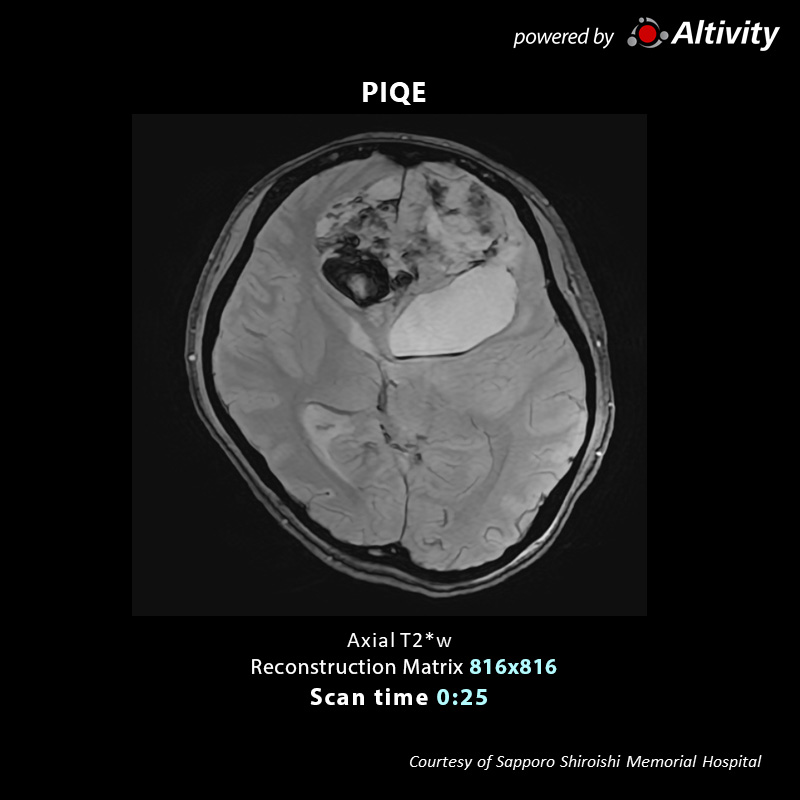
Postoperative Lung Cancer Cranial Metastasis
Vantage Galan 3T
PIQE
Higher resolution imaging with PIQE allows clinicians to provide more precise assessments.
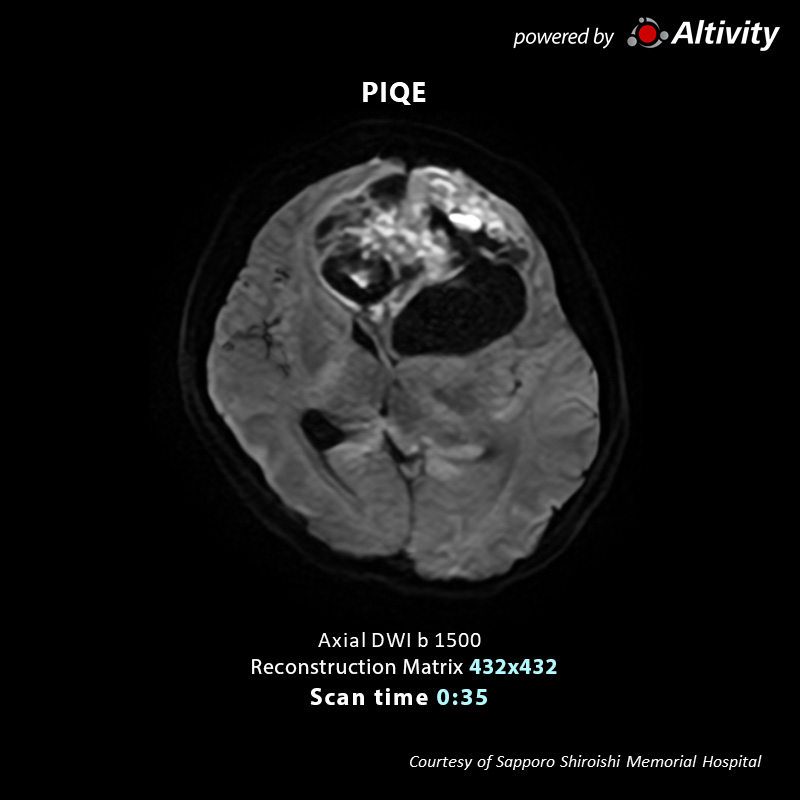
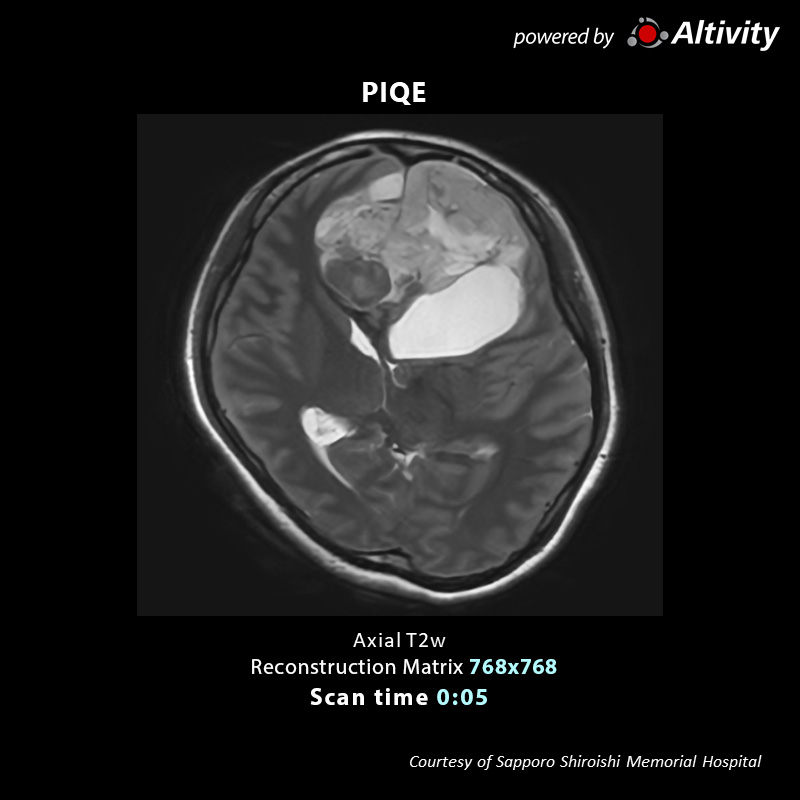
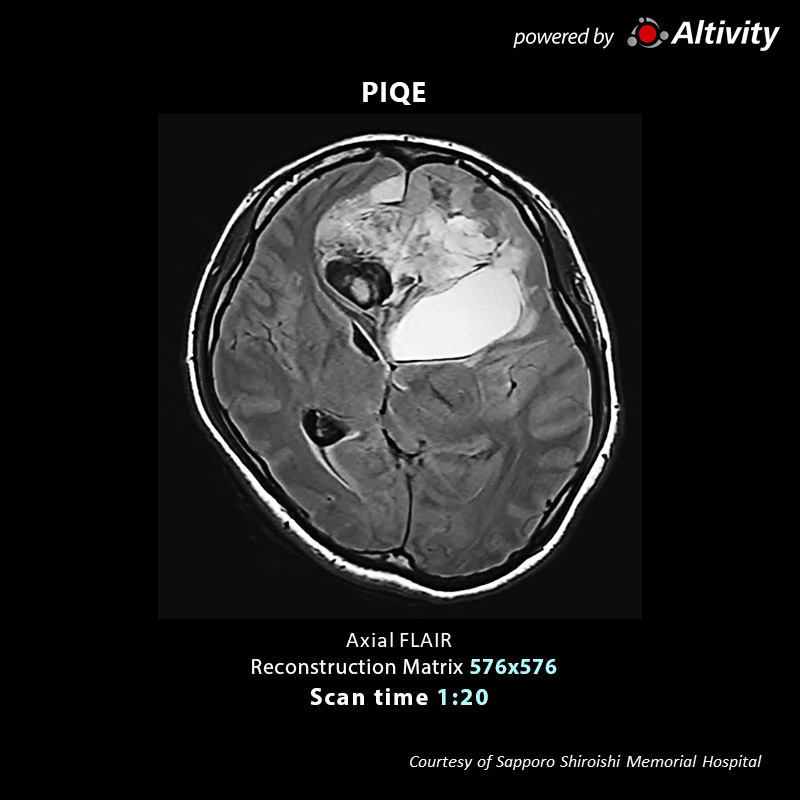
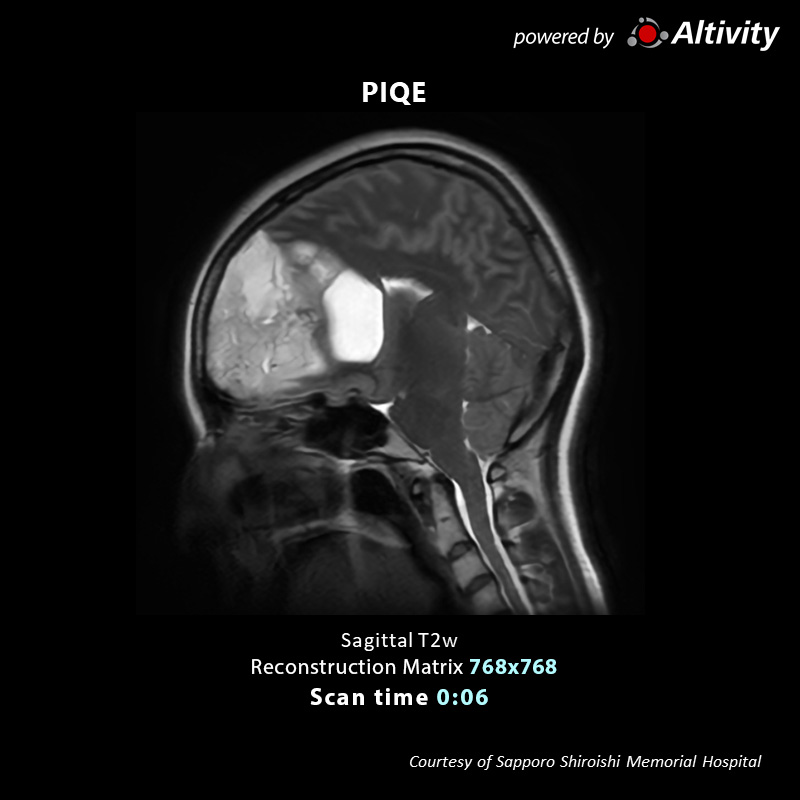
Brain Tumor
Vantage Galan 3T
PIQE
Boundary and the internal structure of the lesion are clearly observed even in a short scan time.
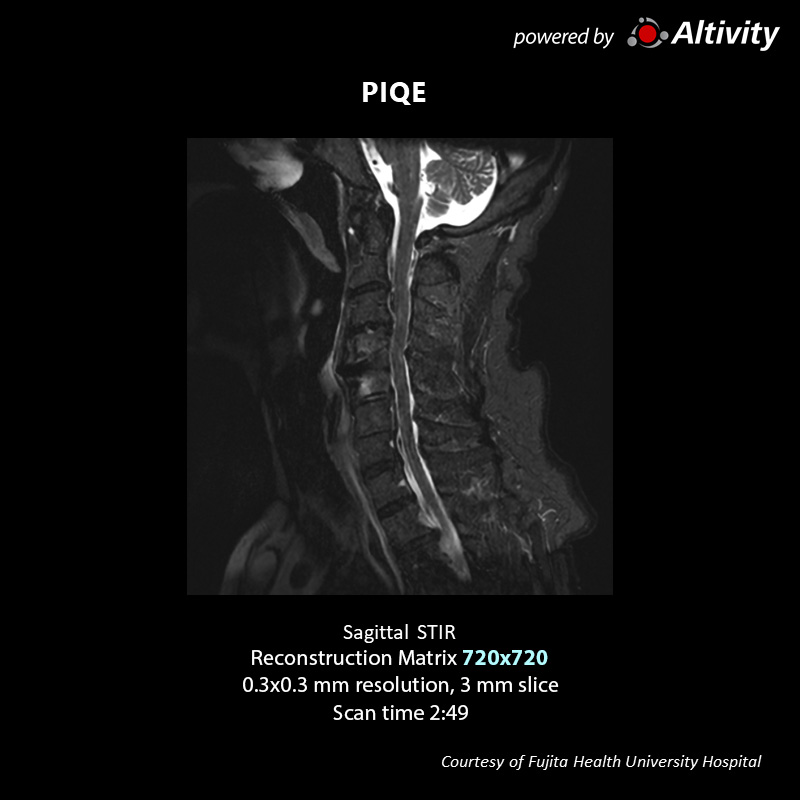
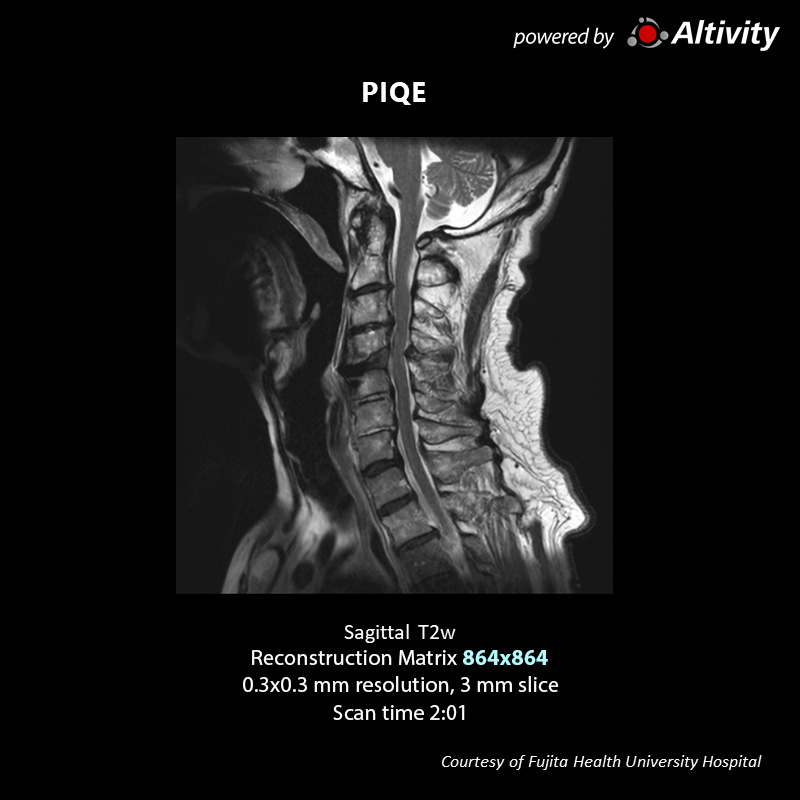
Postoperative Spinal Stenosis
Vantage Galan 3T
PIQE
Higher resolution imaging with PIQE allows clinicians to provide more precise assessments.
Cor T2w for hippocampus
Vantage Galan 3T
PIQE
Aquisition time: 2:18
Common filter
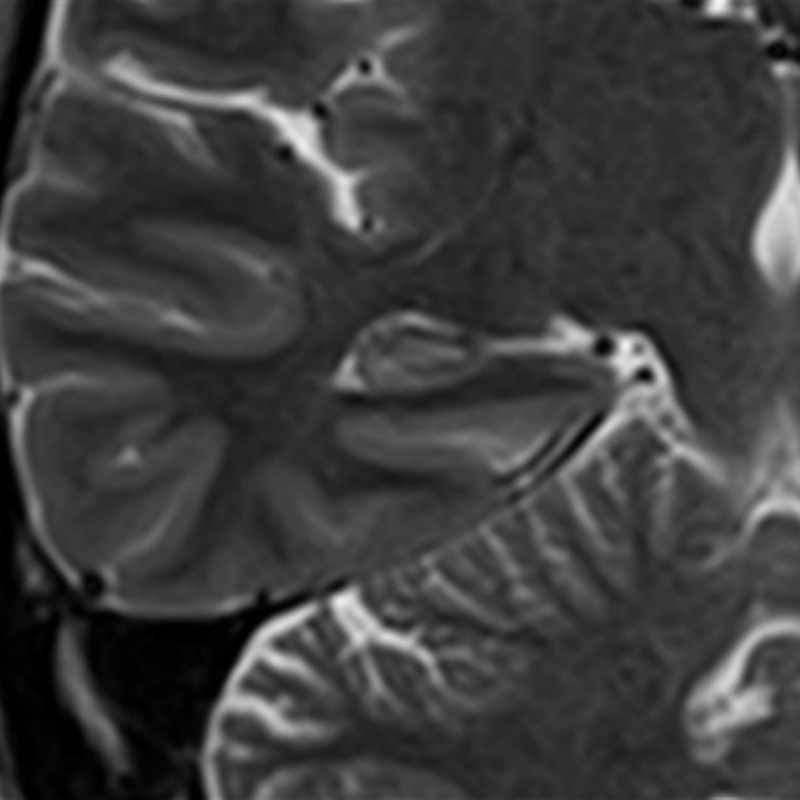
Reconstruction Matrix
256 x 256
PIQE 3x3
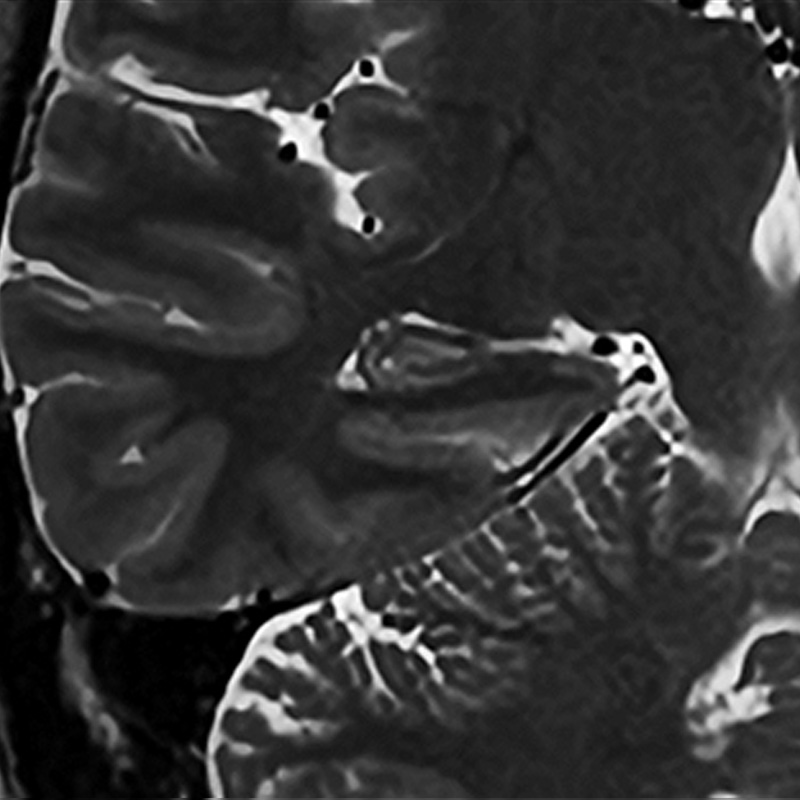
Reconstruction Matrix
768 x 768
Sag T2W for Pituitary
Vantage Galan 3T
PIQE
Aquisition time: 1:08
Common filter
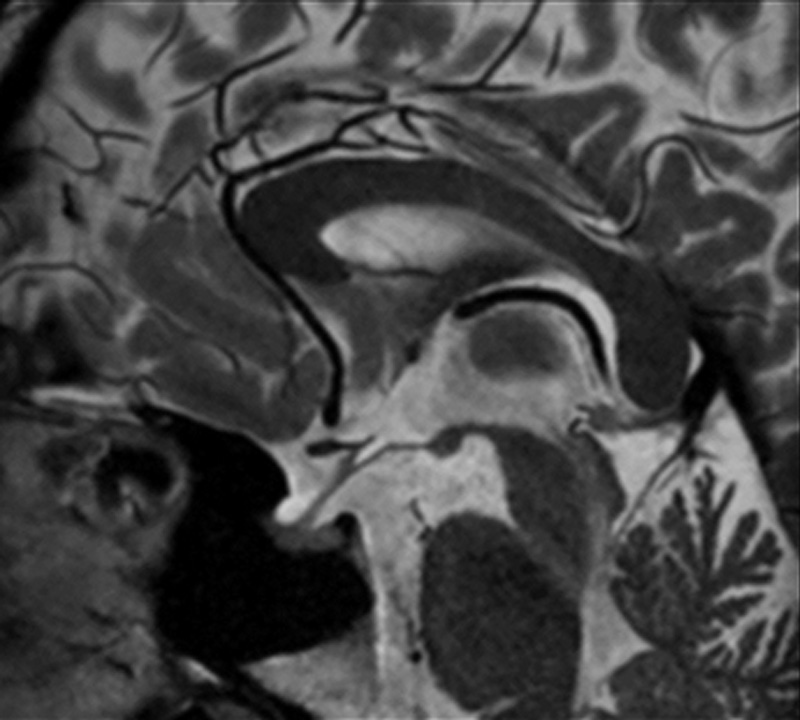
Reconstruction Matrix
256 x 256
PIQE 3x3
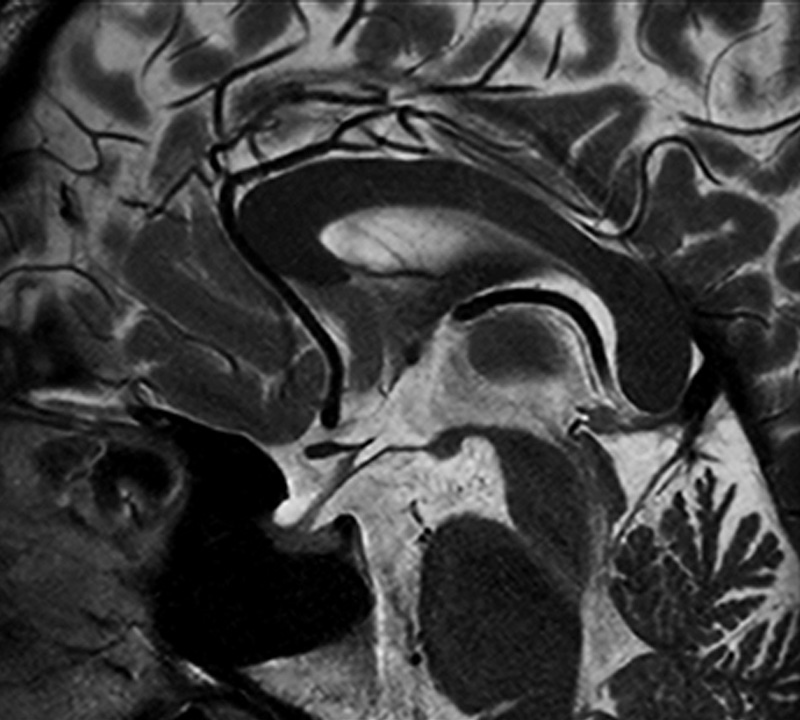
Reconstruction Matrix
768 x 768
Cor T2w slice thickness: 1mm
Vantage Galan 3T
PIQE
Aquisition time: 3:15
Common filter
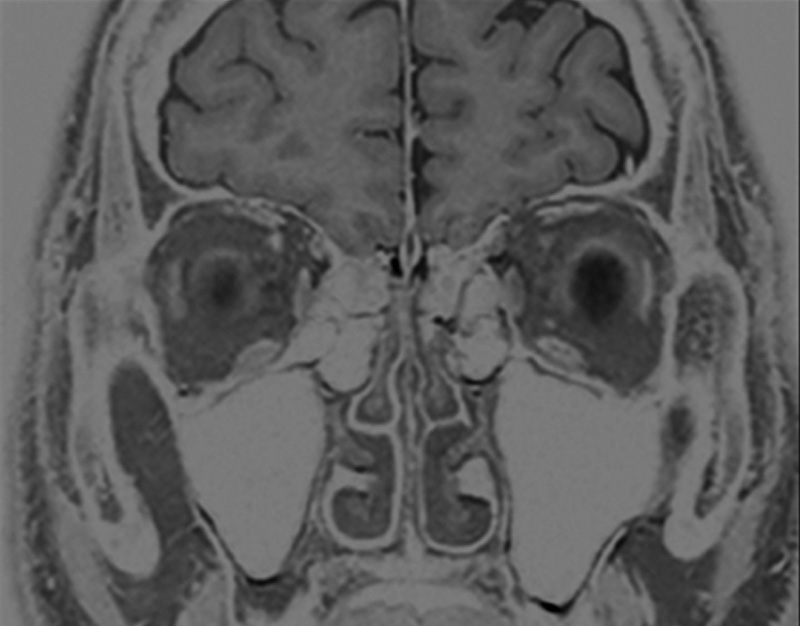
Reconstruction Matrix
256 x 256
PIQE 3x3
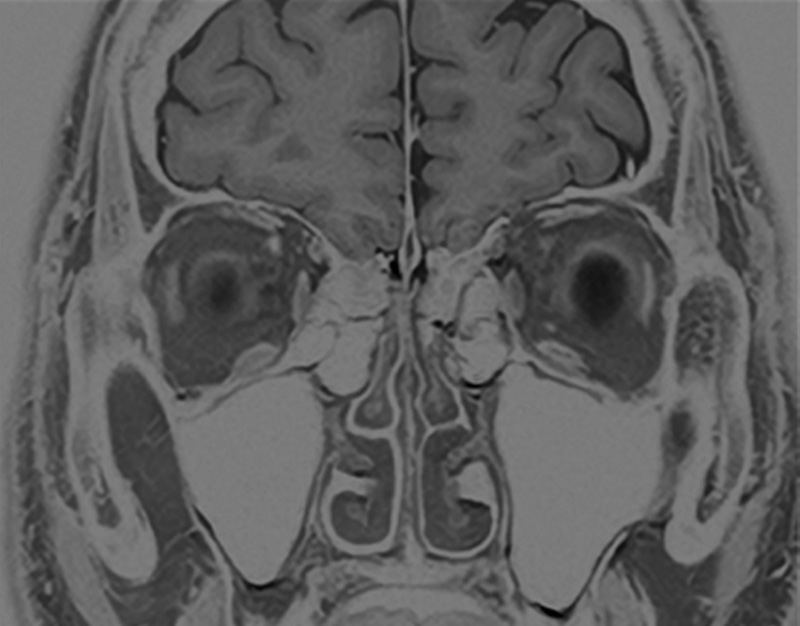
Reconstruction Matrix
768 x 768
Axial T1w for Orbit
Vantage Galan 3T
PIQE
Aquisition time: 1:29
Common filter
Reconstruction Matrix
192 x 192
PIQE 3x3
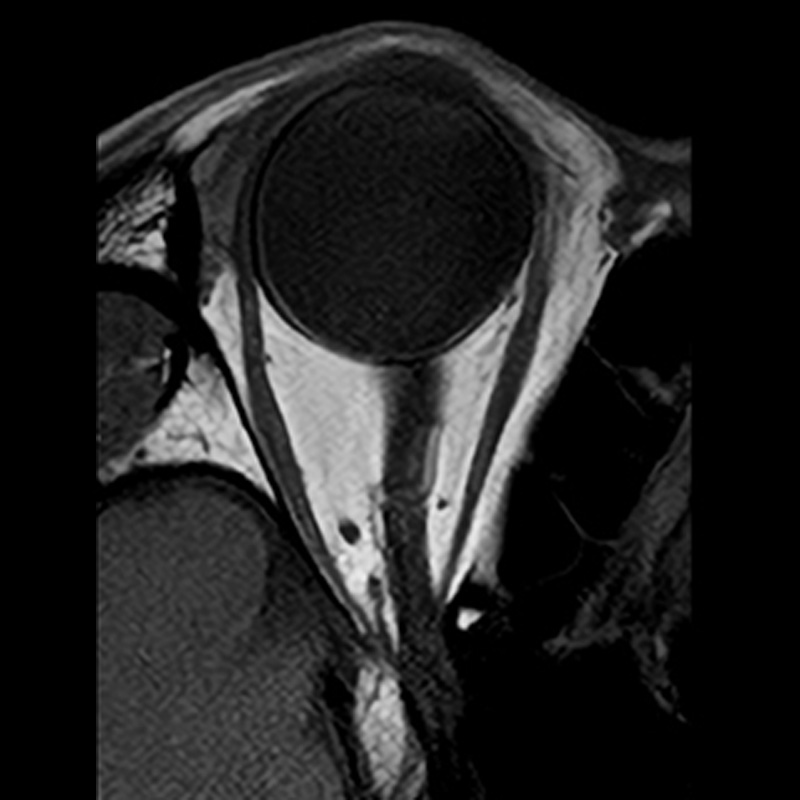
Reconstruction Matrix
576 x 576
Deep Learning Reconstruction for MR: PIQE
Precise IQ Engine (PIQE)
Accelerate high resolution imaging
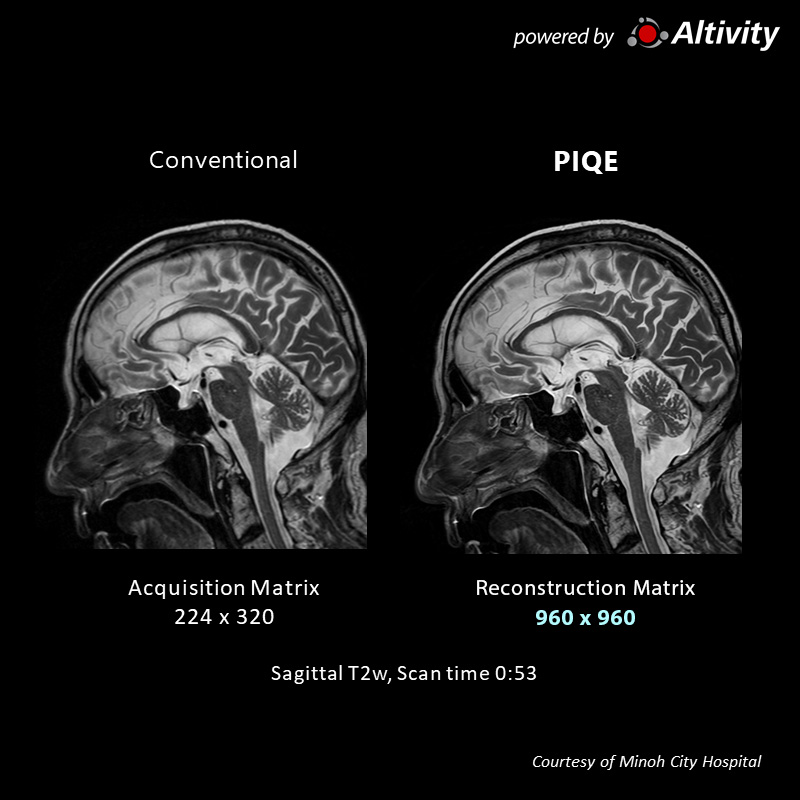
PIQE accelerates scanning by reducing the acquisition matrix and enables acquisition of higher resolution images.
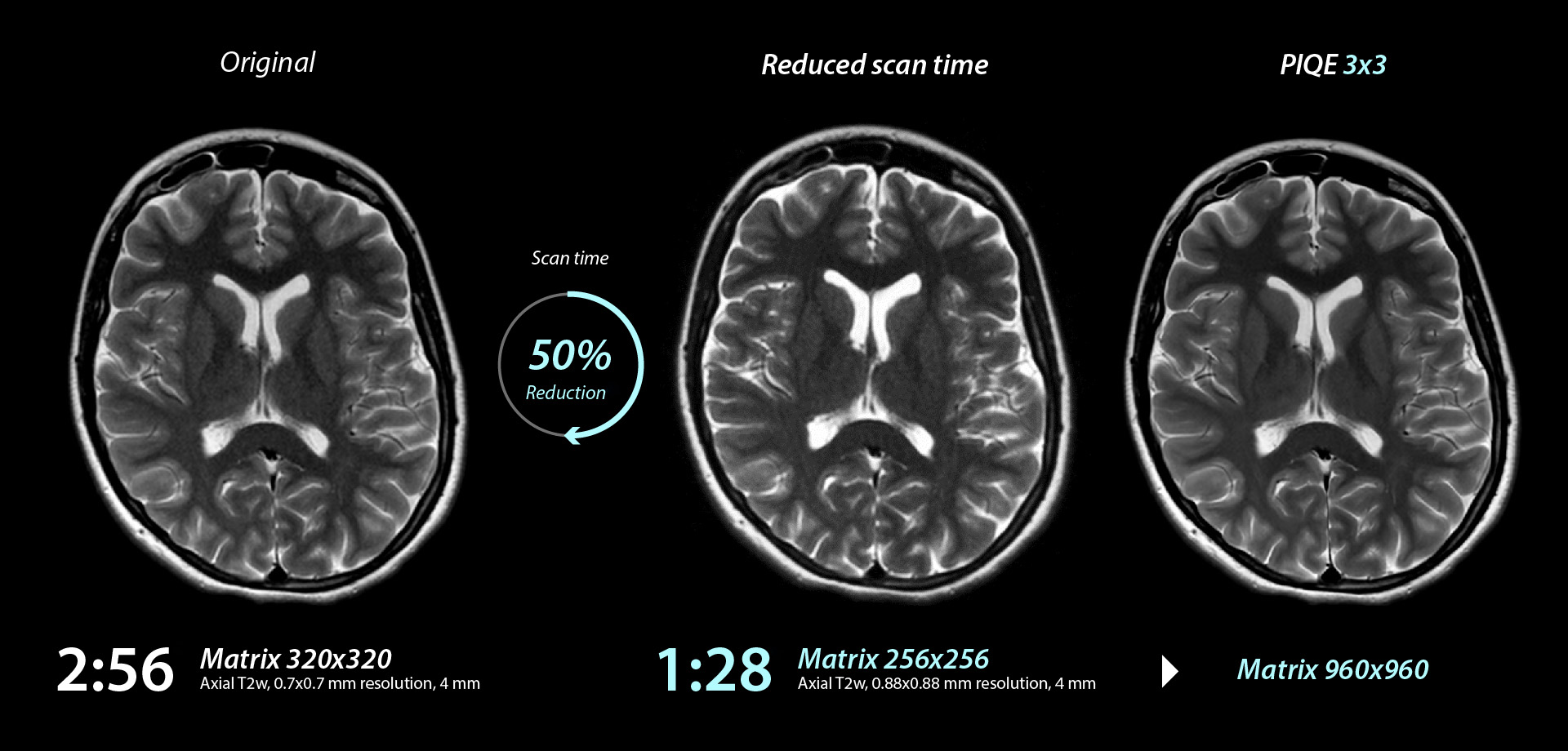
Actual scan time and scan time reductions shown throughout this gallery may vary by case.
